
news

How to Choose Soccer Synthetic Grass for Professional Pitches
How to Choose Professional Soccer Synthetic Grass Through Fiber Parameters
When faced with dozens of soccer synthetic grass products all claiming to be "professional-grade," how do you determine which one truly meets match requirements? The International Federation of Association Football (FIFA) certification is not a mysterious black box; its core standards are directly mapped to three key physical parameters: pile height, density, and fiber weight. Understanding how these parameters work together is the code to unlocking the selection of professional soccer synthetic grass.
Parameter Decoding: The Engineering Language Behind Grass Fibers
Before diving in, let's define three core terms:
Pile Height: The vertical height of a single grass fiber from the backing to its tip, measured in millimeters (mm). It directly affects ball roll behavior and player traction depth.
Density: The number of fiber tufts per unit area, measured in tufts per square meter (tufts/㎡). It determines the turf's fullness, stability, and resilience.
Fiber Weight: More professionally known as Decitex (DTEX), it refers to the weight in grams of 10,000 meters of fiber. It is the core metric for gauging fiber thickness, sturdiness, and wear resistance. A higher DTEX value indicates a thicker, more robust monofilament.
These three parameters do not exist in isolation. They form a "performance triangle" that determines the pitch's final behavior. A high-end turf product is necessarily a balance of these three parameters at high levels.
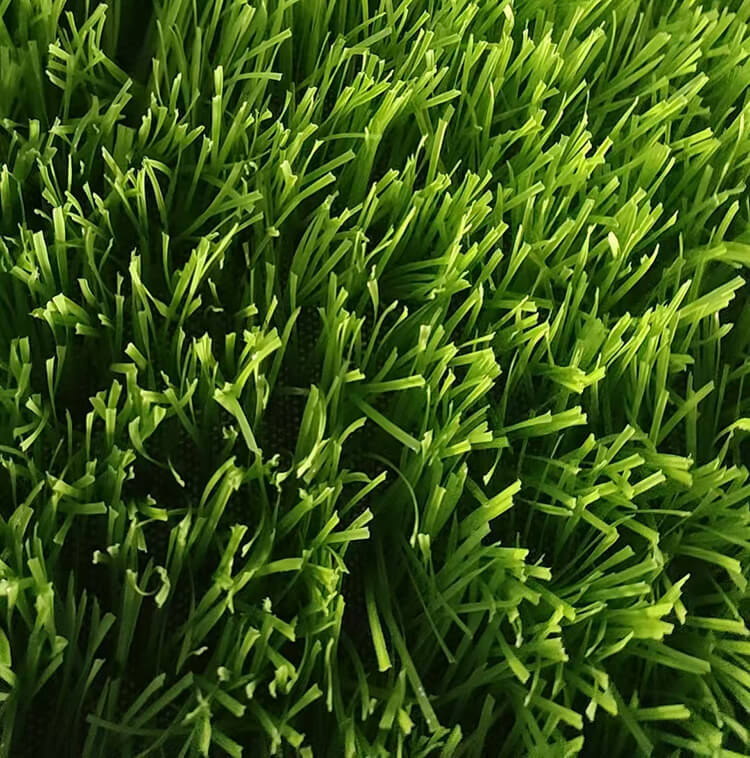
The Performance Triangle: How Parameters Shape the Pitch Experience
1. Pile Height: The Balancer of Ball Speed and Footing Feel
Professional soccer synthetic grass typically has a strictly defined pile height between 40mm and 60mm. This range is FIFA's balance between simulating natural grass performance and ensuring the controllability of synthetic surfaces.
Impact on Ball Speed:
Lower Pile (40-50mm): The ball interacts more with the fiber tips and more directly with the underlying infill, resulting in faster ball roll and more predictable trajectories. This suits a faster, possession-based style of play.
Higher Pile (50-60mm): The ball "sinks" more into the fibers, experiencing greater friction and drag, slowing the ball speed slightly. However, the interaction is softer, potentially offering better control for aerial balls and rebounds.
Link to FIFA Standard: FIFA quantifies this through the "ball roll distance" test. Certification requires the ball to roll 6-10 meters (indoor) or 4-10 meters (outdoor) on a specified slope. Pile height is a key design variable for meeting this standard.
Impact on Footing Feel:
Pile height directly influences the penetration depth of player studs and sliding characteristics. Taller fibers provide more space for studs to embed, potentially increasing rotational resistance (stress on the ankle) but also offering more solid support during sharp stops and turns. FIFA's "rotational resistance" and "sliding distance" tests are directly related.
Selection Guide:
For Professional Matches / High-Intensity Training Pitches: Prioritize 50-60mm pile height. It offers better shock absorption (combined with infill), a feel closer to premium natural grass, and meets the requirements of most FIFA Quality Pro certified pitches.
For Community / High-Frequency Use Pitches: Consider 40-50mm pile height. It is easier to maintain (less prone to matting), facilitates a faster game pace, and is often slightly lower in cost.
2. Density: The Skeleton of Stability and Durability
Density is the turf's "skeleton." While FIFA does not directly specify a density number, its stringent requirements for evenness, uniformity, and vertical deformation indirectly set a threshold. Professional soccer synthetic grass density is typically ≥10,000 tufts/㎡, with premium products reaching over 16,000 tufts/㎡.
Impact on Stability:
High density means fiber roots support each other, effectively resisting lateral forces from cleats and vertical impacts, keeping fibers upright, and preventing local collapse. This is the physical foundation for ensuring uniform performance across the pitch. Players should feel consistent support underfoot, regardless of their position.
It directly impacts FIFA's vertical deformation test (measuring surface depression under force). High-density turf effectively disperses impact forces, reducing depression and providing a more solid push-off feedback.
Impact on Durability:
Density is the first line of defense for durability. High-density turf distributes wear and tear across more, densely packed fibers, significantly delaying the "balding" process caused by fiber breakage and wear. A pitch with insufficient density may show premature performance decay in high-traffic areas like the goalmouth or center circle.
Selection Guide:
Always ask suppliers for the specific density value. 13,000 tufts/㎡ can be considered a key threshold for professional grade.
Judge in combination with fiber weight: For products with similar DTEX, choose the one with higher density.
Visual and tactile check: High-density turf should barely show the backing when viewed from the side, feel thick and full to the touch, and rebound quickly after being pressed.
3. Fiber Weight (DTEX): The Invisible Core of Strength
DTEX is the ultimate metric for measuring the "quality" of the grass fiber. It doesn't directly determine softness but dictates the fiber's tensile strength, abrasion resistance, and recovery memory. Professional soccer synthetic grass typically has a DTEX value above 8000, with top-tier products exceeding 12000.
Fundamental Impact on Durability:
High-DTEX fibers are like sturdier "steel rebar," with stronger molecular chains that resist:
1. Abrasion: Repeated scraping from cleats and friction from the ball.
2. UV Degradation: High-DTEX fibers usually have more stable polymer structures and better anti-aging properties.
3. Fatigue Fracture: Better ability to recover their original shape after repeated bending.
A simple analogy: Two fibers of the same height, the 10000 DTEX one will have a much longer "lifespan" than the 6000 DTEX one, especially under sun, rain, and high-intensity use.
Subtle Impact on Performance:
Resilience: High-weight fibers have better shape memory, springing back faster after being compressed, maintaining a lush appearance and consistent performance over time.
Support: It provides the substantial "content" for high density, together building a strong load-bearing network.
Selection Guide:
Treat DTEX as the most critical quality indicator. For any pitch intended for official matches or high-intensity training, do not accept products below 8000 DTEX.
Beware of the "high pile height, low fiber weight" combination: This can lead to turf that looks full but has weak fibers prone to matting and rapid wear.
Request raw material data: Reputable suppliers should be able to provide DTEX test reports for the fiber masterbatch.
Integrated Decision-Making: Cracking the Parameter "Combination Code"
A single outstanding parameter does not signify excellence; true professionalism lies in exquisite balance. Here are two typical high-performance combination patterns:
Pattern A: Balanced Performance
Pile Height: 50mm | Density: 13,000 tufts/㎡ | DTEX: 10,000
This is a classic configuration for many pitches with FIFA Quality certification. It achieves an excellent balance between ball speed, footing feel, durability, and cost, suitable for most professional club training grounds and high-quality public pitches.
Pattern B: Extreme Durability
Pile Height: 55mm | Density: ≥15,000 tufts/㎡ | DTEX: ≥12,000
Aimed at pitches with extremely high usage frequency (e.g., football academies, all-weather public pitches) or harsh environments (strong UV, large temperature swings). The extremely high density and fiber weight ensure unparalleled wear resistance and an extended service life, but at a correspondingly higher cost.
Key Advice to Avoid Pitfalls:
1. Beware of "Parameter Inflation": Require suppliers to provide third-party test reports verifying pile height, density, and DTEX.
2. Reject the "Short Plank in the Barrel": A product with one extremely high parameter but average others often has performance flaws. For example, very high pile height combined with low density and low DTEX results in turf that is soft, unstable, and hard to maintain.
3. Link to Certification: Ultimately, the value of all parameters must be reflected in FIFA test results. When selecting a product, you must review its corresponding laboratory test report to confirm that key data like shock absorption and ball roll meet the certification requirements (FIFA Quality or FIFA Quality Pro) you are targeting.
Choosing professional soccer synthetic grass is a rational process of translating physical parameters into sporting experience. Pile height sets the physical framework of the game, density builds a stable and uniform stage, and fiber weight guarantees the long-term, reliable operation of it all.
Next time you evaluate a soccer synthetic grass product, ask directly for these three numbers. They will tell you more than any marketing language about whether this pitch can withstand 90 minutes of intense running, allow for precise ground passes, and still maintain its professional character five years later. Remember, the true "code" to FIFA certification is written in these solid engineering parameters.
0users like this.

